
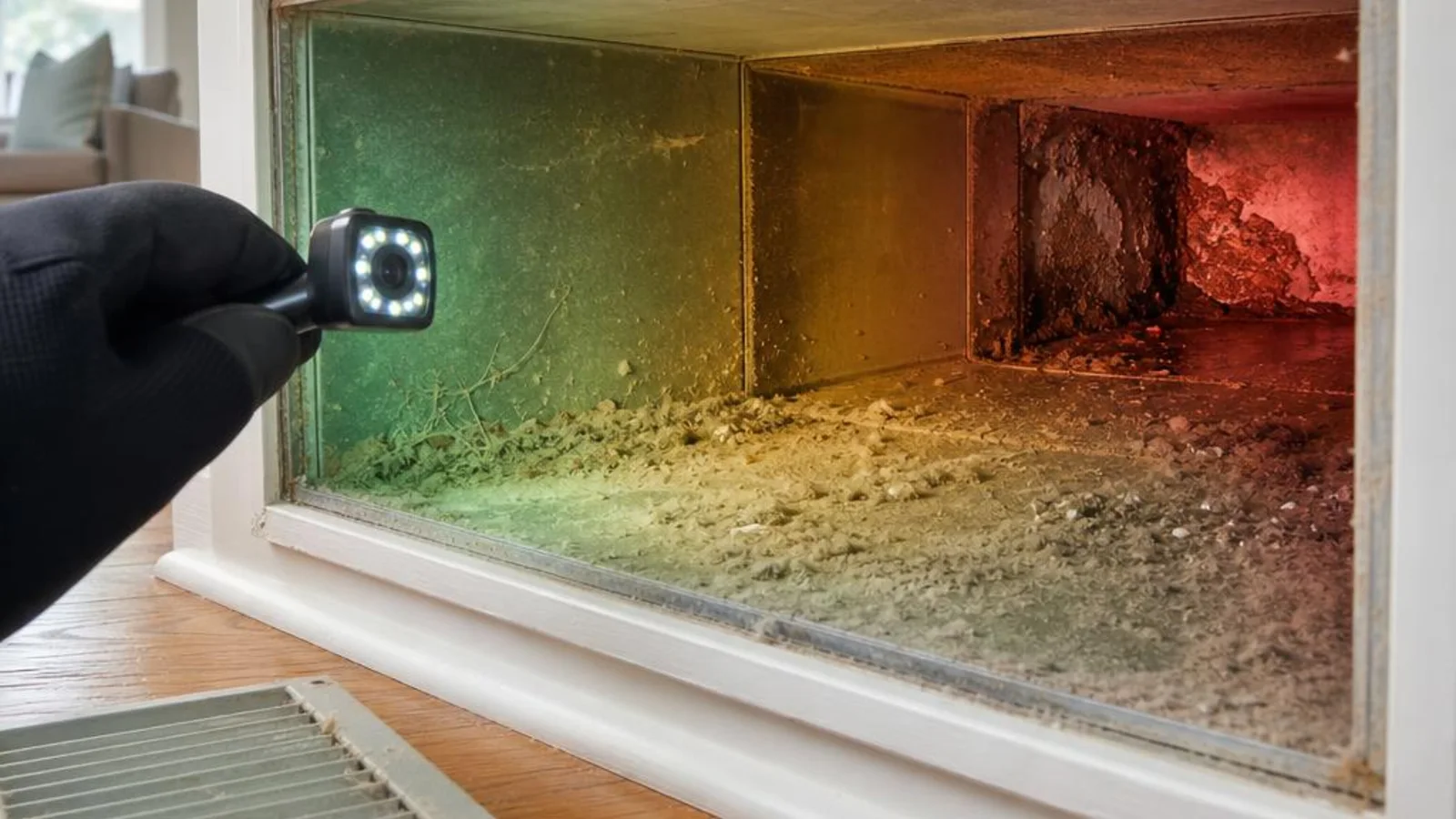
A dusty register can look alarming, but it does not tell the whole story. Before you book a cleaning—or dismiss a real problem—here are seven lesser-known facts that help Hampton Roads homeowners make a more informed decision.
1. Most dust in a duct does not automatically blow into your rooms
The U.S. Environmental Protection Agency (EPA) says much of the dirt in air ducts adheres to duct surfaces and does not necessarily enter the living space. It also notes that particles from outdoor air and everyday activities—including cooking, cleaning, and moving around—can contribute more to people’s exposure than dirty ducts do. A dusty vent cover by itself is not proof that the whole system needs cleaning.
The EPA does not recommend routine duct cleaning on a fixed schedule. It says to consider it when there is substantial visible mold growth in hard-surface ducts or on system components, a vermin infestation in the ducts, or excessive dust and debris—or particles actually coming into the home from supply registers.
2. A very low coupon may not cover the whole system
A low advertised price is not automatically a scam, but it may describe a limited service rather than cleaning an entire HVAC system. Ask what the coupon includes: supply and return runs, registers, the air handler, blower, coils, and other components may be priced or scoped differently. Get the full scope and any add-on charges in writing before work begins.
The EPA consumer guide lists a broad historical price range of $450–$1,000 per system, but those figures are historical and should not be treated as current local pricing. In Hampton Roads, a qualifying single-zone whole-home cleaning from Universal Duct Cleaning starts at $312; the final scope depends on the system, access, condition, and any needed source correction. Compare written scopes—not just coupon headlines.
3. The wrong cleaning method can damage ductwork
Cleaning is not simply “more suction is better.” The EPA advises consumers to ask how the provider will protect the home, control debris, and clean the system’s components. It recommends controlled brushing with contact vacuuming and calls for soft-bristled brushes on fiberglass duct board and internally lined sheet-metal ducts. Aggressive tools or untrained work can damage delicate materials, including flexible duct.
Ask the company to identify your duct material before choosing a method, explain how loosened debris will be contained and removed, and show you the condition of accessible areas. A photo-first inspection can help establish whether the issue calls for cleaning, repair, moisture correction, or no work at all.
4. Bugs near a vent do not prove bugs came through the ducts
Finding a spider, mosquito, moth, or millipede near a register is not proof that it lived in or traveled through the ductwork. The EPA lists a vermin infestation in the ducts as a reason to consider cleaning, but a bug beside a vent is not the same evidence. Look for the pest’s actual entry point and address that source first; duct cleaning is not pest control.
If you find insects around a register in Great Neck or elsewhere in Virginia Beach, avoid assuming the duct is the source. Universal Pest & Termite in Virginia Beach can assess a pest concern separately from an HVAC inspection.
5. Wet or moldy insulated ductwork may need replacement—not scrubbing
Fiberglass duct board and internally lined ducts need material-appropriate care. The EPA says insulated air ducts with insulation that has become wet or moldy cannot be effectively cleaned and should be removed and replaced; the moisture problem also needs correction or growth may return. Do not scrub deteriorating or wet fiberglass yourself. Have the material and condition assessed before anyone recommends cleaning or replacement.
6. Cleaning alone may not fix the cause
If a return is pulling air from a dusty crawl space, a duct is disconnected, or moisture keeps entering the system, cleaning may be temporary. The EPA emphasizes correcting the underlying cause before cleaning, retrofitting, or replacing ducts. Otherwise, the contamination can recur.
That is especially relevant in coastal Hampton Roads, where homes from Great Neck toward the Lynnhaven River have different duct layouts, crawl spaces, and moisture conditions. A local inspection should document the actual system rather than assume every home has the same issue.
7. “Looks like mold” is not the same as a confirmed diagnosis
The EPA cautions that a substance that looks like mold may need expert assessment or laboratory analysis to confirm what it is. Ask to see the specific area and the evidence behind a recommendation. Be cautious about pressure to buy a chemical treatment or sealant: the EPA says the effectiveness and potential health effects of these products in duct cleaning have not been fully researched.
What should you do before booking?
- Ask for an inspection and photos of the accessible ductwork.
- Get the cleaning scope, system count, and any separate charges in writing.
- Ask how the tools will be matched to your duct material.
- Correct moisture, pest entry, or damaged ductwork before expecting cleaning to solve the issue.
- Skip routine cleaning when there is no documented reason; the EPA recommends cleaning as needed, not on an automatic annual schedule.
For a no-charge photo inspection, see our Free Photo Inspection details. If the inspection identifies a pest source, our sister company Universal Pest & Termite handles pest assessment; if attic or crawl-space insulation needs attention, Universal Insulation Doctor can evaluate that part of the home.
One yearly plan for ongoing home care
The Total Home Health Subscription offers tiered benefits under one yearly fee. Depending on the tier, benefits can include duct cleaning, dryer-vent cleaning, pest control, and an annual multi-point inspection of the ducts, attic, and crawl space; the complete set is included with the Elite plan. There are no contracts, and you can cancel anytime.
Sources: EPA, “Should You Have the Air Ducts in Your Home Cleaned?” (consumer guidance with a historical cost estimate).