
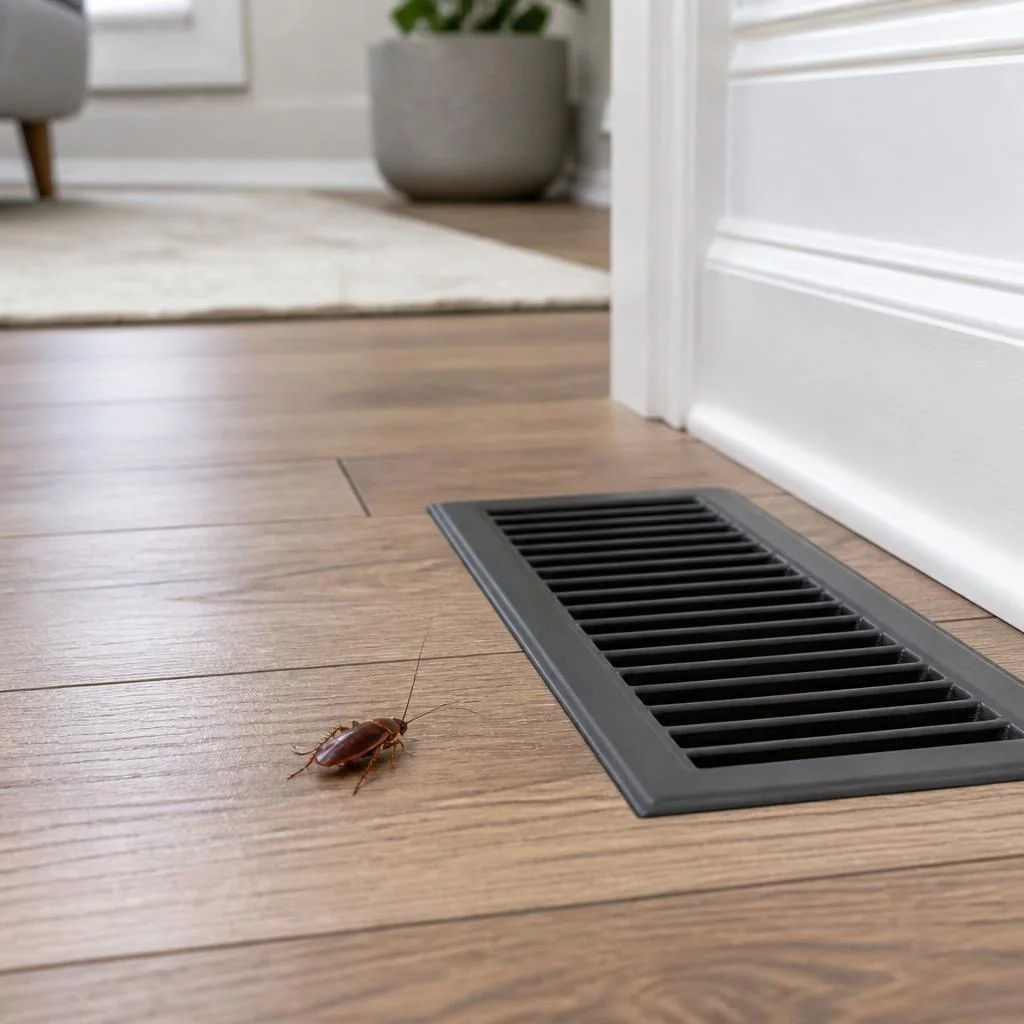
Finding a large cockroach near a floor or wall register can be unsettling. In Hampton Roads, people often call the American cockroach a “palmetto bug.” But the insect’s location alone cannot tell you where it came from: seeing one beside a register does not prove it traveled through the ductwork.
Before booking duct cleaning or applying a treatment, separate what you observed from what you can’t yet know. A pest professional can identify and address pest activity; a duct inspection can document the accessible condition of the HVAC system. One does not replace the other.
What a bug near a register does—and doesn’t—tell you
A single sighting may mean the insect entered the room from somewhere else, or it may be associated with activity that needs a closer look. Proximity to a vent is not enough to establish an entry route, an infestation inside the ducts, or a need for whole-system cleaning.
A visible gap around a grille also does not, by itself, show that the duct is open or that an insect used it. The register, boot, nearby floor or wall, and the duct beyond it are different parts of the system and may need separate assessment.
- Take a photo from a safe distance if you need help identifying the insect.
- Note where and when you saw it, and whether sightings are repeated.
- Look for a pattern without reaching into a register or disturbing suspected pest evidence.
When to contact a pest professional
If you see roaches repeatedly, notice egg cases, or find other signs of pest activity, contact a pest-control professional. They can identify the species, look for conditions or entry points relevant to the pest, and recommend a treatment plan. Universal Pest & Termite provides cockroach control for Hampton Roads and has a Norfolk pest-control service page.
Do not spray insecticide, fogger, air freshener, or household cleaner into a supply or return register. Products should only be used as their labels direct; spraying into HVAC equipment can leave residue and does not establish or fix the source of pest activity.
When a duct inspection may be useful
A duct inspection is a separate step if you have a duct-specific concern, such as visible damage, unusual debris at an opening, or a register or boot that appears loose. A photo inspection can document what is visible and accessible. It cannot prove where a roach came from or replace a pest inspection.
If an inspection finds material inside accessible ductwork, the next step should match those findings. Cleaning is not pest treatment, and it should not be recommended just because an insect was spotted nearby. When cleaning is appropriate, Universal Duct Cleaning uses rotary-brush agitation and direct-contact vacuuming; pest identification and control should be handled by a pest professional.
If you are in Ocean View or Ghent and want the HVAC side checked, you can request a free photo inspection before deciding whether any duct work is needed.
Keep crawlspace and insulation questions separate
If a separate home assessment identifies a crawlspace moisture or insulation concern, address that condition with the appropriate home-service professional. It may be worth reviewing Universal Insulation Doctor’s Norfolk insulation services or its information on Norfolk crawlspace encapsulation. Insulation or crawlspace work is not pest control and does not establish how a particular insect entered a room.
Total Home Health, with tiered benefits
The Total Home Health Subscription is a yearly plan with tiered benefits. Depending on the tier, services may include duct cleaning, dryer-vent cleaning, pest control, and a multi-point inspection of ducts, attic, and crawlspace; the full set of benefits is available on Elite. There are no contracts, and you can cancel anytime. Review the plan details to see which tier fits your home.
The practical takeaway: call pest control for repeated or confirmed pest activity, and consider a duct inspection only when you have a separate reason to check the HVAC system. A bug beside a register is a clue to observe—not proof of a duct infestation.