
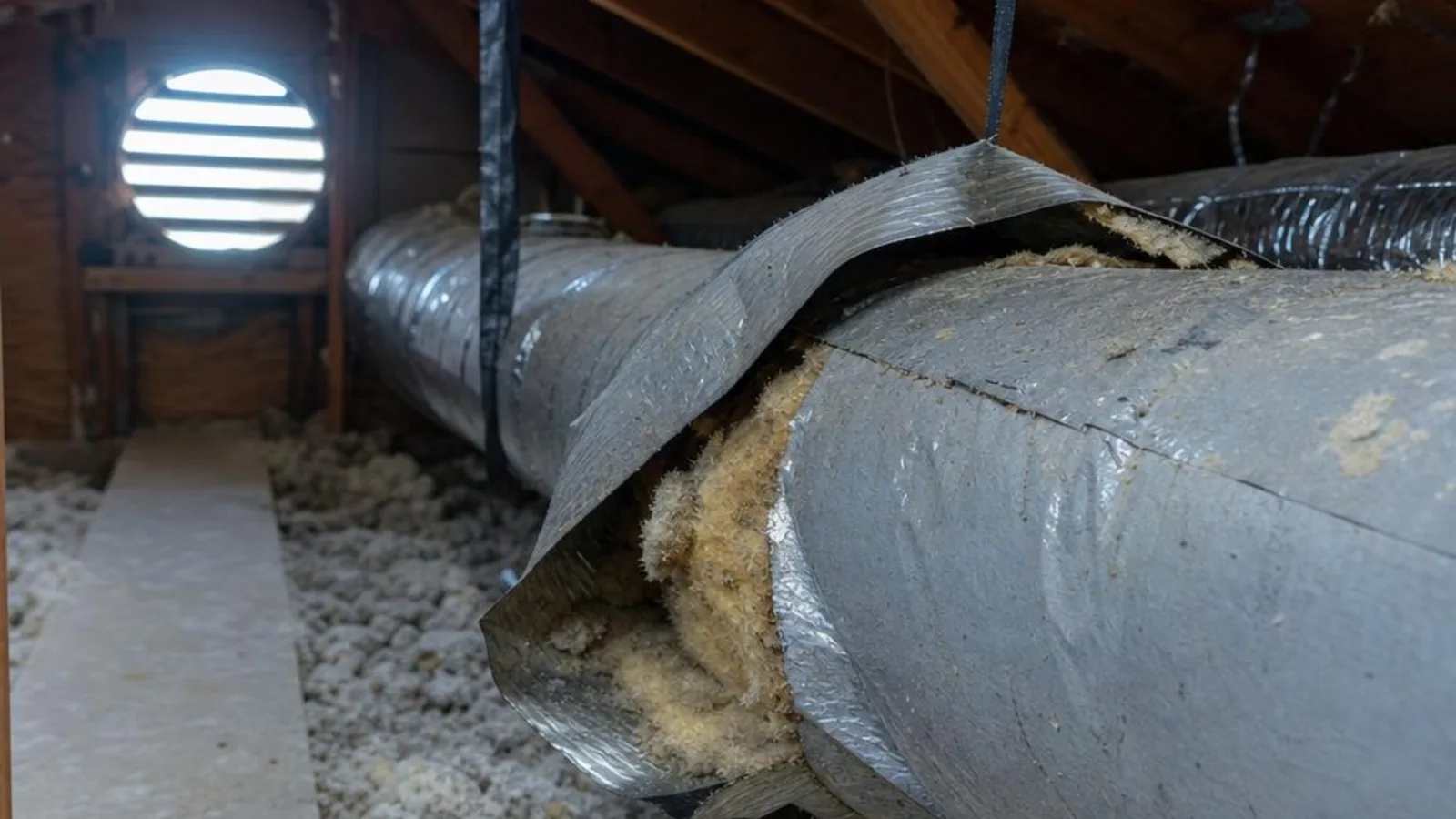
If certain rooms in your Hampton home feel drafty and cool all winter while your thermostat is set well above that, the problem may not be your furnace. Attic ductwork with deteriorated insulation — cracked outer jackets, split seams, or bare flex duct exposed to unconditioned attic air — quietly bleeds heat on every run between the air handler and the register. By the time the warm air arrives at the grille, much of it is gone.
The good news: the fix is usually straightforward once someone has actually looked at the ductwork. The catch is that very few Hampton homeowners have ever seen the inside of their attic duct system. This guide walks you through the warning signs, what our technicians look for during a free photo inspection, and how to decide whether repair or replacement is the right call before winter heating season begins.
What Attic Duct Insulation Actually Does
Flex duct in an unconditioned attic is surrounded by air that can hit 130°F in a Hampton summer and drop to near freezing on the coldest January nights. The duct’s outer insulation layer — typically R-6 or R-8 fiberglass batting wrapped in a foil-reinforced jacket — is the only barrier keeping your conditioned air from exchanging temperature with whatever the attic happens to be that day.
When that insulation layer fails, you lose heat in winter and gain it in summer, and neither HVAC upgrade nor filter change will fix the underlying waste.
Signs of Deteriorated Attic Duct Insulation in Hampton Homes
- Rooms that never reach setpoint. A bedroom or far corner of the house stays noticeably cooler than the thermostat’s setting, especially in rooms served by long duct runs crossing the full width of the attic.
- Visible jacket damage. Cracked, torn, collapsed, or missing foil jacket on attic flex duct is a direct sign the insulation beneath it is either exposed or compressed to near-zero R-value. Pest activity — common in Hampton attics near Fox Hill and Wythe — can chew through jackets completely.
- Split or separated seams. Flex duct is assembled in sections; over years of thermal cycling and vibration the inner liner, insulation layer, and outer jacket can pull apart at connection points. Separated seams dump conditioned air directly into the attic.
- Sagging, kinked, or coiled runs. Flex duct that has come loose from its supports sags, kinks, or coils on itself. A kinked run chokes airflow; a sagging run compresses its own insulation at the low point, reducing the effective R-value.
- Dust rings around supply registers. Dark streaking or fuzz around ceiling registers often indicates conditioned air is picking up attic particulate through a seam leak or breach before it exits the grille.
- High heating costs without obvious cause. No specific room complaint, but your monthly gas or electric bill climbs every winter even though the system is maintained and the home is otherwise well-sealed.
Why Hampton Attics Are Harder on Duct Insulation
Hampton sits at the tip of the Virginia Peninsula, bounded by the Chesapeake Bay, Hampton Roads harbor, and tidal marshland. That coastal position brings three conditions that shorten duct insulation lifespan compared to drier inland climates:
- Humidity plus jacket damage. If the outer vapor jacket is torn or its seams fail, humid attic air can reach the fiberglass beneath it. Insulation that is visibly damp, matted, or compressed may perform poorly, but a photo inspection is needed to determine the actual condition.
- Temperature extremes. The combination of intense radiant heat in summer and cold snaps in winter stresses both the foil jacket and the adhesive holding it at seams faster than a moderate climate would.
- Wildlife activity. Squirrels, raccoons, and starlings are regular attic visitors in established Hampton neighborhoods. Animal nesting in or around flex duct compresses and shreds insulation; claw damage to jackets is common.
Free Photo Inspection: See the Condition Before You Decide
The most common mistake Hampton homeowners make when facing comfort complaints is replacing an entire duct system before knowing whether the damage is localized. Our free photo duct inspection sends a technician into the attic with a camera. You see every run, every seam, every section of jacket — photos documented before any work begins. That evidence answers the core question: is this a targeted repair job or a system that has reached end of life?
Some attics show two or three compromised sections that can be re-insulated and re-jacketed for a modest cost. Others reveal a full system with original builder-grade R-6 flex duct that has reached the end of its useful life and would benefit more from full replacement with new R-8 insulated runs. The inspection drives the recommendation, not the other way around.
Repair vs. Replacement: How We Think About It
- Repair makes sense when: Damage is limited to one to three sections, the rest of the jacket and insulation is intact, and the inner liner shows no collapse or tears. Re-insulating and re-jacketing affected runs, reconnecting separated seams, and re-strapping sagging sections can restore a system to good working order.
- Replacement makes sense when: The original duct is builder-grade R-6 that was undersized for current HVAC tonnage, damage is spread across most of the system, the inner liners show cracking or collapse at multiple points, or the system is old enough that spot repairs will only delay the inevitable by a season or two.
We will always tell you which category your system falls into and why — with photo documentation so you can see the reasoning. We do not recommend replacement when repair will do the job.
What Happens During an Attic Duct Repair or Replacement
For repairs, our technicians re-wrap insulation to specified R-value on damaged sections, re-seal all connections with mastic and metal-backed tape, and re-strap sagging runs so they hold their shape through another decade of temperature cycling. For full replacement, we remove the existing system, install new R-8 insulated flex duct sized for your system’s airflow needs, mastic-seal every joint, and support runs at proper intervals to prevent sagging. Every step is photo-documented.
If pests are involved — active or past — we coordinate with Universal Insulation Doctor in Hampton, our sister company, to ensure the attic insulation surrounding your ductwork is also assessed, since damaged duct jackets and degraded attic insulation often go hand in hand.
Fall Is the Right Time to Act
Scheduling a duct inspection and any necessary repair or replacement before the heating season starts means the work happens when your attic is accessible at a reasonable temperature — not mid-January when technicians are working in freezing conditions. It also means the first cold snap reveals a comfortable home rather than a callback call.
We serve Hampton neighborhoods including Fox Hill, Wythe, Phoebus, Buckroe Beach, and Greater Wythe. Most inspection appointments are available within a few days. Call us at (757) 962-0419 or schedule your free photo inspection online.
Total Home Health Subscription
Duct inspection, attic assessment, and dryer vent cleaning are all covered under our Total Home Health Subscription — one yearly fee with tiered benefits. The full set of services, including the annual multi-point duct, attic, and crawl space inspection, comes with the Elite plan. No contracts, cancel anytime. It’s the easiest way to make sure attic ductwork gets eyes on it every year, not just when a problem surfaces.