
When Norfolk nights turn cooler in late summer and fall, homeowners often notice two things at roughly the same time: energy bills that don't drop as expected and rooms that aren't getting the airflow they should. Sometimes the explanation is straightforward — a dirty filter, an aging system. But in homes with flex duct in the crawl space, the answer may be in the crawl space itself, where small animals seeking warmth have discovered that the outer jacket of a flex duct run makes useful nesting material.
This article covers the warning signs, explains what rodent damage actually does to ductwork, and walks through the right sequence for addressing it — pest exclusion first, then duct evaluation and repair or cleaning.
Why Flex Duct Is Vulnerable in Norfolk Crawl Spaces
Flexible duct is a practical and cost-effective choice for residential HVAC runs, but its construction — a spiral wire core wrapped in an inner vinyl liner and surrounded by insulation and an outer polyethylene jacket — gives small animals exactly what they look for in a nesting site. The outer jacket is easy to chew, the insulation batting inside is warm and soft, and the whole run is sheltered, dark, and generally undisturbed for months at a time. In Norfolk neighborhoods like Larchmont and Park Place / Colonial Place, where homes often sit on crawl-space foundations with older vents and gaps around pipe penetrations, a determined mouse or rat needs very little invitation.
Warning Signs of Rodent Flex Duct Damage
You usually don't need to crawl under the house to suspect a problem. These signs often show up first from inside the living space:
- One or two rooms significantly weaker in airflow. If a bedroom or den that used to cool easily now feels stuffy while the rest of the house is comfortable, a chewed or torn run to that zone is a common explanation.
- Musty or organic odor from specific registers. Rodent debris — droppings, nesting material, urine — can produce an unmistakable smell. If one vent smells different from others in the same system, it may be close to the damage site.
- Unexplained increase in energy bills without a system change. A supply duct with a hole or torn jacket is conditioning the crawl space rather than the room the run is supposed to serve. The system runs longer to compensate, and the bill reflects it.
- Sounds from the crawl space around dusk or dawn. Scratching, scurrying, or light thumping noises are worth taking seriously before they become a larger infestation.
- Visual evidence at the crawl space access. Droppings near the hatch, smear marks on the access frame, or chewed insulation visible near an opening are all indicators that something has been living down there.
What Rodent Damage Actually Does to the Ductwork
There are two distinct layers in a flex duct run, and damage to each has different consequences:
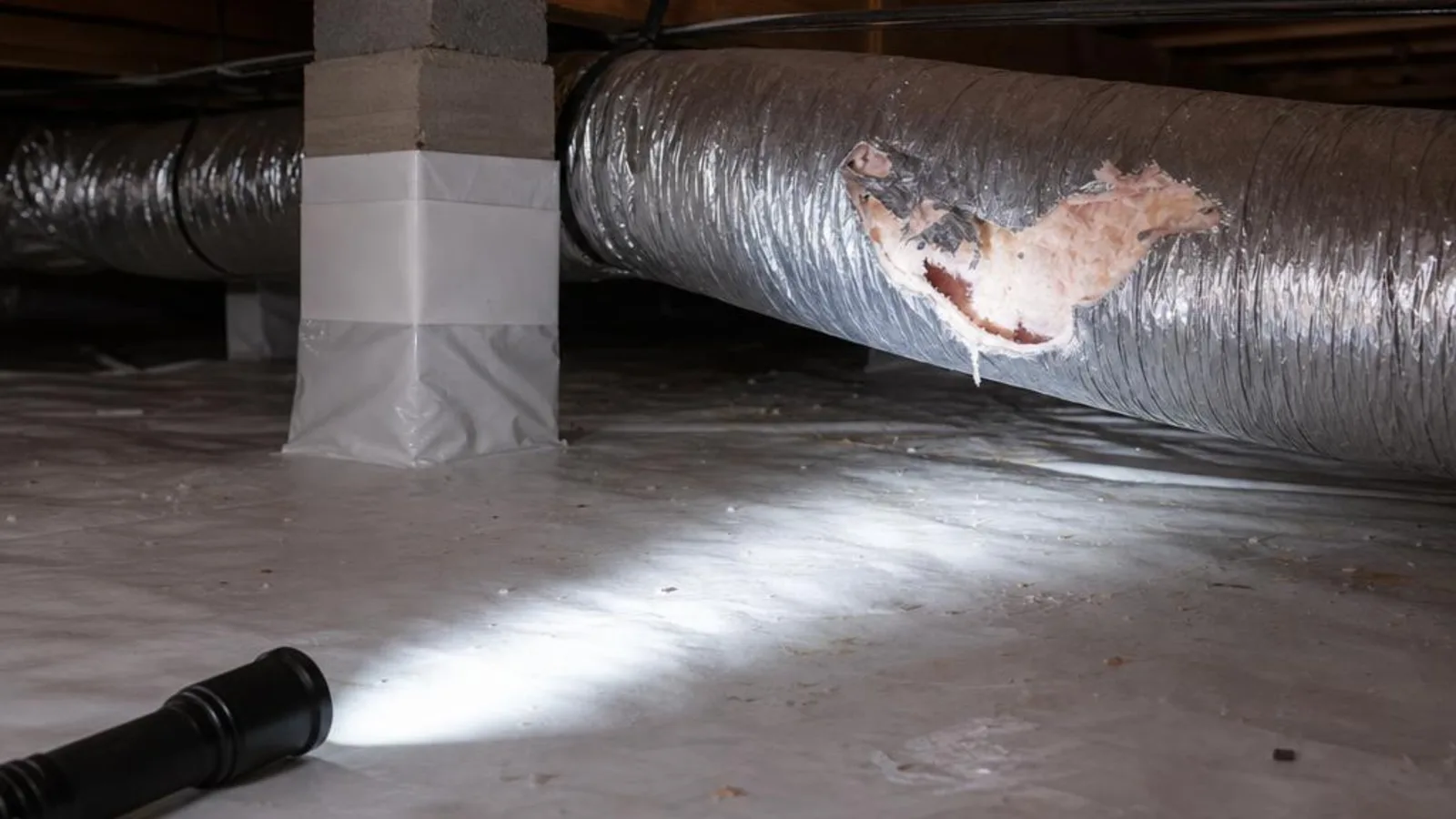
- Outer jacket damage. The polyethylene outer layer protects the insulation batting from moisture and mechanical damage. When it's chewed or torn, insulation becomes exposed, absorbs crawl-space humidity, and begins to lose its thermal performance. The duct still carries air — the inner liner may be intact — but the run loses efficiency and the exposed insulation can become a habitat for biological growth over time.
- Inner liner damage. The inner vinyl liner is what actually contains the conditioned air. When rodents chew through it — as they often do when boring into the insulation for nesting — conditioned air escapes directly into the crawl space. This is the scenario that causes the most immediate and measurable impact: visible airflow reduction at the register, longer HVAC run times, and in some cases significant energy waste until it's discovered and repaired.
It's worth being clear about one thing: a chewed duct liner does not automatically mean contaminated air is blowing into your rooms. Whether there's meaningful concern depends on the location and extent of the damage, the direction of airflow through that section, and what's near the breach. A supply duct delivers air under positive pressure away from the opening; in most cases the leak blows outward rather than drawing in. This doesn't mean damage should be left unaddressed — it should be repaired — but it's worth understanding the actual mechanics rather than assuming the worst.
Why Pest Exclusion Comes First
The most important sequence note: if there is an active or recent rodent problem in the crawl space, pest exclusion must happen before any duct repair or replacement. Repairing a flex duct run before closing the entry points that allowed the rodents access is a short-term fix. Within one season, newly repaired ductwork can be back in the same condition. Our sister company Universal Pest & Termite serves Norfolk and can handle exclusion work, treatment, and monitoring — we often coordinate with them on jobs where rodent evidence is found during our duct inspection.
Duct Evaluation and Repair: What the Process Looks Like
Once pest exclusion is addressed (or if the evidence suggests rodents are no longer active), the duct side of the work follows a consistent sequence:
- Free photo inspection. A camera goes inside the accessible duct runs and a technician visually assesses the crawl space sections. Photos document the condition of the outer jacket and any visible inner liner damage, disconnected sections, or collapsed runs.
- Targeted repair or replacement. Minor outer jacket damage can sometimes be addressed with approved duct repair tape and re-insulation. Sections with inner liner damage — particularly where the wire core has been compromised — are typically replaced with new R-8 insulated flex duct. Repair or replacement is quoted by section based on what the inspection actually finds, not as a whole-system assumption.
- Duct cleaning evaluation. If the inspection reveals debris, droppings, or nesting material has entered the duct interior through the breach, a targeted cleaning of the affected run (and potentially the wider system depending on the extent) may be appropriate. This is assessed on a case-by-case basis after seeing what the camera shows — we won't quote a whole-house cleaning when a targeted clean is the honest recommendation.
Serving Larchmont, Park Place, and Surrounding Norfolk Neighborhoods
Our crews work throughout Norfolk, including Larchmont, Park Place / Colonial Place, and the wider Norfolk area. We schedule free photo inspections most days of the week, and most appointments are available within a few days. Call (757) 962-0419 or use our online scheduler if you'd like us to take a look.
Total Home Health Subscription
Rodent-related duct issues are exactly the kind of problem our Total Home Health Subscription was designed to catch early. One yearly fee covers a tiered package of services — duct cleaning, dryer vent cleaning, pest control coordination, and an annual multi-point duct, attic, and crawl space inspection. The full set of benefits is available on the Elite plan. Tiered options let you choose the level of coverage that fits your home. No contracts, cancel anytime. When the annual crawl space inspection is included, problems like chewed outer jackets are spotted before they become inner liner failures.
If you've noticed recent airflow or odor changes, schedule a free photo inspection — we'll show you what's actually in your ductwork before recommending any service.