
If you've ever noticed a musty, earthy smell drifting up from the floors in your Portsmouth home — especially when the AC kicks on or a stiff breeze blows outside — you've likely encountered the stack effect at work. It's a natural physics phenomenon, not a flaw in your house, but understanding it helps explain why a simple air freshener never quite fixes the problem and why the real answer starts in the crawl space.
What the Stack Effect Actually Is
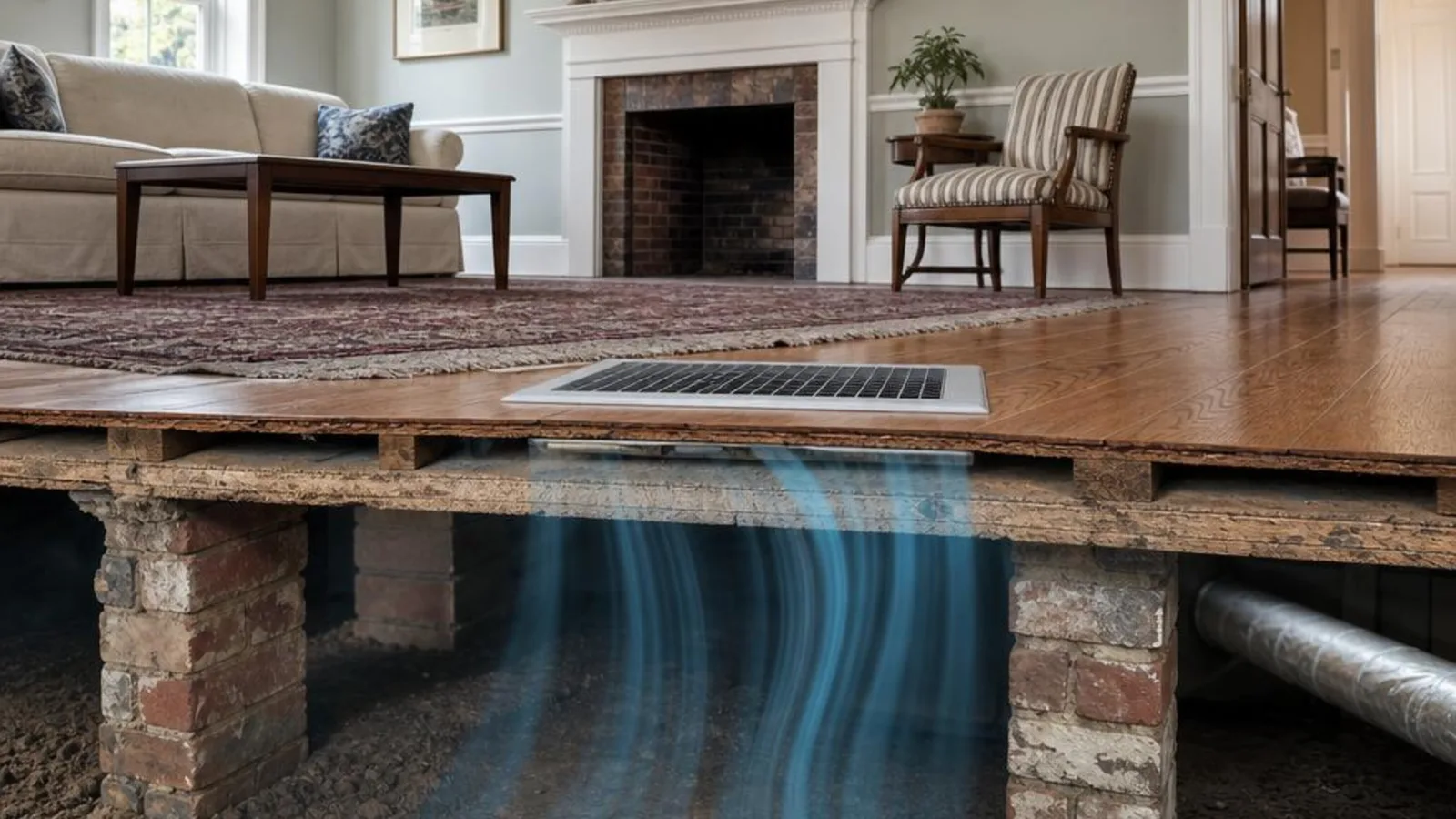
Warm air rises. In any home, air pressure is slightly higher near the top of the structure and slightly lower near the bottom. That pressure difference — called the stack effect or chimney effect — causes air to be drawn in at low points and pushed out at high points. In a two-story Portsmouth colonial or a single-story home over a vented crawl space, the "low points" are floor gaps, penetrations around pipes and wiring, and — critically — leaky duct boots and return connections at or near floor level.
Portsmouth's older housing stock in neighborhoods like Olde Towne and Churchland tends to have vented crawl spaces rather than conditioned ones. That crawl space fills with the region's signature humid summer air, and when the stack effect does its work, some of that air — along with whatever organic odors are down there — gets pulled steadily upward into the living areas.
How Ductwork Becomes Part of the Problem
Not every home with a vented crawl space has a serious odor problem. The stack effect becomes a more noticeable issue when the ductwork running through that crawl space has gaps or leaks that let crawl-space air enter the system and distribute it to every room. There are three common leak points to understand:
- Duct boot gaps. The metal boot — the fitting that connects the duct run to the floor or wall register — often develops small gaps between the boot flange and the subfloor over time. Those gaps draw crawl-space air directly into the supply stream.
- Return duct leakage. Return air ducts operate under negative pressure, which means any gap, loose joint, or disconnected connection actively sucks surrounding air into the system. A return with even a small hole in the crawl space can pull significant volumes of damp, musty air and push it right through your home's HVAC system.
- Disconnected or sagging flex duct. In Portsmouth crawl spaces — where humidity softens tape and straps can fail — flex duct sometimes pulls loose at collar connections or sags low enough that any pooled moisture near it gets drawn in. A connection that's only partially attached may look fine until a camera goes inside.
It's important to say clearly: not every crawl-space odor issue is a duct problem. If the crawl space itself has standing water, significant organic debris, or elevated moisture levels, those conditions need attention at the source. Our work is the duct side of the equation — inspection, sealing, and cleaning — and we'll be honest if what we find points to a moisture problem that a duct cleaning alone won't resolve.
The Three-Part Approach: Inspect, Seal, Clean
When a Portsmouth homeowner calls us about musty smells tied to the HVAC system, we follow a consistent sequence because skipping any step leaves part of the problem unsolved.
Step 1: Inspect — See What's Actually There
A free photo duct inspection is always the starting point. A technician puts a camera inside the duct system and photographs every accessible supply and return run, boot connection, and trunk joint. The photos accomplish two things: they show whether duct interior buildup is contributing to the odor, and they document any visible leak points, disconnected sections, or moisture damage that explains how crawl-space air is getting in.
We may also look at the condition of register boots and their contact with the subfloor. If boot gaps are the primary entry point, sealing those is often a quick, targeted fix that makes an immediate difference.
Step 2: Seal — Close the Entry Points
Sealing identified leak points stops the stack effect from using your duct system as a chimney for crawl-space air. This includes mastic-sealing loose collar connections and trunk joints, re-securing any sections of flex duct that have pulled loose, sealing boot-to-subfloor gaps with appropriate materials, and ensuring return connections in the crawl space are fully intact and airtight. Sealing before cleaning matters because a full cleaning of a leaking system just exposes freshly cleaned interior surfaces to the same infiltrating air all over again.
Step 3: Clean — Remove What's Already Inside
Once the entry points are addressed, rotary-brush and direct-contact HEPA-vacuum cleaning removes accumulated dust, debris, and any biological buildup from inside the duct runs. For systems with persistent musty odor, an EPA-registered antimicrobial sanitizing treatment can be applied after mechanical cleaning as an add-on option — it's always itemized separately and never a surprise charge.
If after inspection the odor source is primarily a crawl-space moisture issue rather than duct contamination, we'll tell you that directly. Addressing a wet crawl space — whether through improved drainage, vapor barrier work, or encapsulation — falls outside our direct duct services, but we'd rather give you an honest assessment than perform a cleaning that won't solve the problem you called about.
What to Do Right Now If You Smell Something
- Note whether the smell is strongest at floor-level registers versus high-wall or ceiling registers — floor registers are most directly exposed to boot gaps.
- Check whether the odor is worse when the system first starts versus after it runs for several minutes — stronger on startup can suggest air that pooled in the duct between cycles, pointing to infiltration.
- Look for any visible moisture, staining, or rust around floor register covers, which can indicate condensation at a sweating boot.
- Schedule a camera inspection before any work — you should see the evidence before any cleaning is performed or any charge is quoted.
Serving Portsmouth Neighborhoods
Our crews work throughout Portsmouth regularly, from the historic streets of Olde Towne to the residential corridors of Churchland. If you'd like to schedule a camera inspection or have questions about whether what you're experiencing is a duct issue, call us at (757) 962-0419 or use our contact form.
Total Home Health Subscription
Managing crawl-space air quality involves more than one trade — and that's exactly why we built the Total Home Health Subscription. One yearly fee covers a tiered package of services: duct cleaning, dryer vent cleaning, pest control coordination, and an annual multi-point duct, attic, and crawl space inspection. The full set of benefits comes with the Elite plan. No contracts, cancel anytime. For insulation and vapor barrier work around your crawl space ductwork, our sister brand Universal Insulation Doctor serves Portsmouth and can address the thermal and moisture envelope that the duct system depends on.
Ready to find out what's going on in your ducts? Schedule your free photo inspection — no cleaning is quoted until you've seen the inside of your own system.