
Your furnace or heat pump can run longer while conditioned air quietly escapes through a gap at a register, a loose duct joint, or an opening in the home’s outer shell. That can leave a room uncomfortable and add to heating or cooling costs. Around Greenbrier in Chesapeake, start with what you can observe—then have the right part of the system checked rather than assuming every draft means the same repair.
Did you know? Two useful national estimates
- Leaky ducts can lose 20%–30% of the air moving through the duct system. That is ENERGY STAR’s estimate for a typical house with leaks, holes, or poorly connected ducts. It is a share of air moving through the ducts—not a claim that every home loses that percentage of its energy bill. Your home’s actual loss depends on duct condition, location, system operation, and other factors.
- Air sealing plus insulation may lower heating and cooling costs by an average of 15%. ENERGY STAR attributes this estimate to EPA modeling of cost-effective air sealing and insulation improvements in typical existing U.S. homes. It is not a guaranteed result, and it does not describe vent-grille sealing or duct repair alone.
Those numbers describe two related but different problems. Duct leaks let heated or cooled air escape from the HVAC distribution system. Home-envelope leaks let outdoor air move through gaps in walls, doors, windows, attic openings, and other boundaries. Sealing one does not automatically fix the other.
Three places air can escape near a vent
- At the register-to-ceiling or register-to-wall edge. A loose grille or visible gap may allow room air to move around the boot—the short fitting connecting the register to the duct. That gap is different from a leak farther inside the duct.
- At a duct joint or connection. Loose, poorly sealed, disconnected, or damaged ducts can leak conditioned air, especially where ductwork runs through an attic, crawl space, or other unconditioned area. A room-side draft alone does not confirm that a hidden duct is disconnected.
- Through the home’s exterior envelope. Drafts may enter around doors, windows, plumbing or wiring penetrations, attic hatches, and other openings. A home energy assessment can help locate these leaks and identify appropriate air-sealing and insulation work.
Safe ways to look for a draft
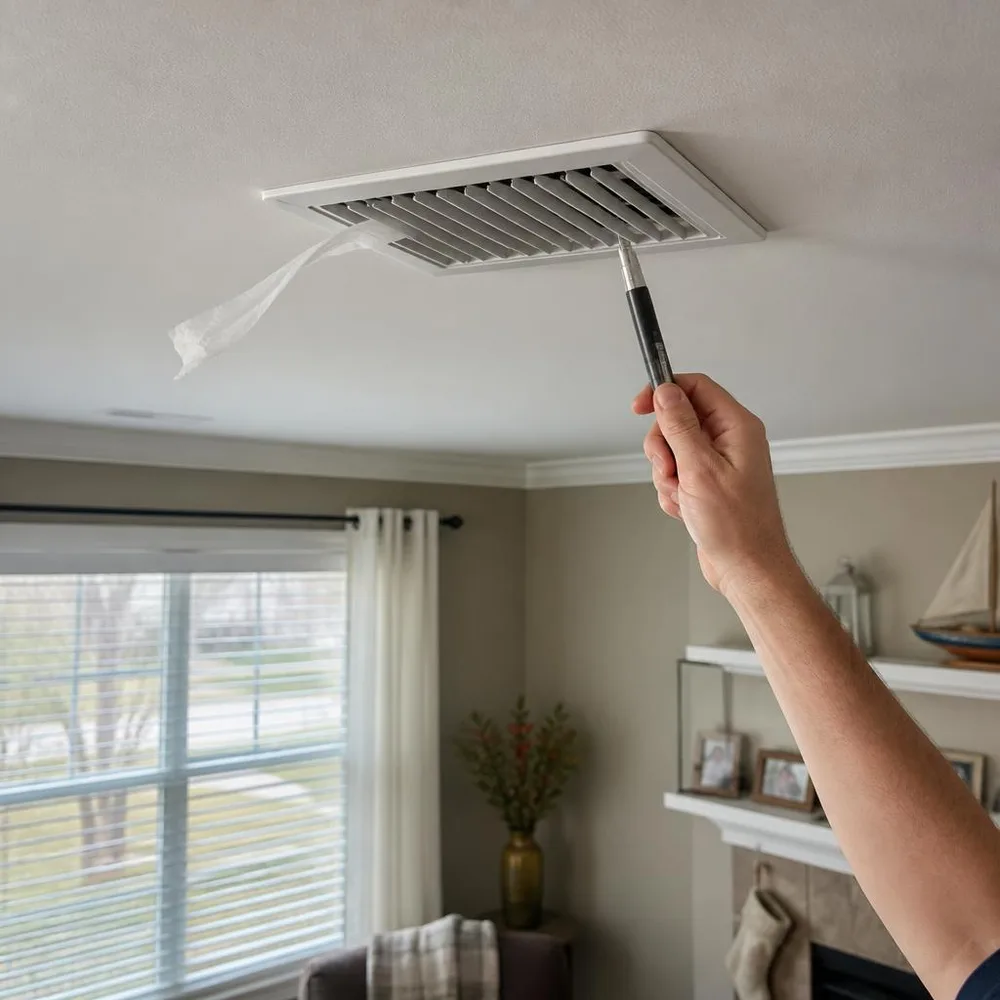
On a cool or windy day, close exterior doors and windows, turn off fans that could confuse the test, and feel for moving air around the closed register’s outer edge. A light strip of tissue held near the edge may show movement; keep it clear of the grille and moving equipment. Do not use a candle or open flame to search for leaks. Do not remove a register, reach into ductwork, or cover a supply vent to test it.
Also note which rooms feel drafty, whether the problem changes when the HVAC system runs, and whether the register is loose or visibly separated from the wall or ceiling. For hidden envelope leaks, a qualified home-energy professional can use diagnostic tools such as a blower-door test. For a suspected duct leak, a qualified HVAC contractor can inspect and test the duct system. The right test depends on where the air is escaping.
Chesapeake landmarks, different homes, same need to check
From Greenbrier near the Chesapeake Arboretum, through Great Bridge near the Battlefield Boulevard bridge and Chesapeake City Park, to Deep Creek and Northwest River Park, a landmark cannot tell you whether a particular home has a leak. The construction, duct layout, and repair needs of each home have to be assessed on site. We serve Chesapeake neighborhoods including Greenbrier and Great Bridge.
If you find a gap around a register, avoid stuffing it with household materials or using ordinary cloth-backed duct tape. ENERGY STAR recommends appropriate mastic sealant or metal tape for duct sealing, and a professional can confirm whether the issue is at the register boot, a hidden duct connection, or somewhere else. For attic or crawl-space insulation concerns, Universal Insulation Doctor serves Greenbrier. If a pest-related opening is involved, Universal Pest & Termite serves Greenbrier and Chesapeake.
Where duct inspection fits
A photo inspection can document accessible duct interiors and visible connection conditions. It is not a blower-door test, an energy audit, or a guarantee of energy savings. If the concern is air escaping around the register or hidden in the home envelope, ask an HVAC or home-energy professional to evaluate that specific area. If accessible ductwork has visible debris, damage, or a loose connection, the findings can help determine whether cleaning, repair, or another step is appropriate.
To have accessible ductwork checked, see our free photo inspection. We will show what is visible before recommending duct cleaning; a photo inspection does not replace a qualified HVAC contractor’s equipment diagnosis or a home-energy assessment.
Sources
- ENERGY STAR: Duct Sealing — typical duct leakage estimate and guidance about common register and duct connection leak locations.
- ENERGY STAR: Why Seal and Insulate? — estimated average heating and cooling cost savings from air sealing combined with insulation.
- City of Chesapeake: Chesapeake Arboretum.
- City of Chesapeake: Parks & Trails, including Chesapeake City Park.
- City of Chesapeake: Northwest River Park & Campground.