
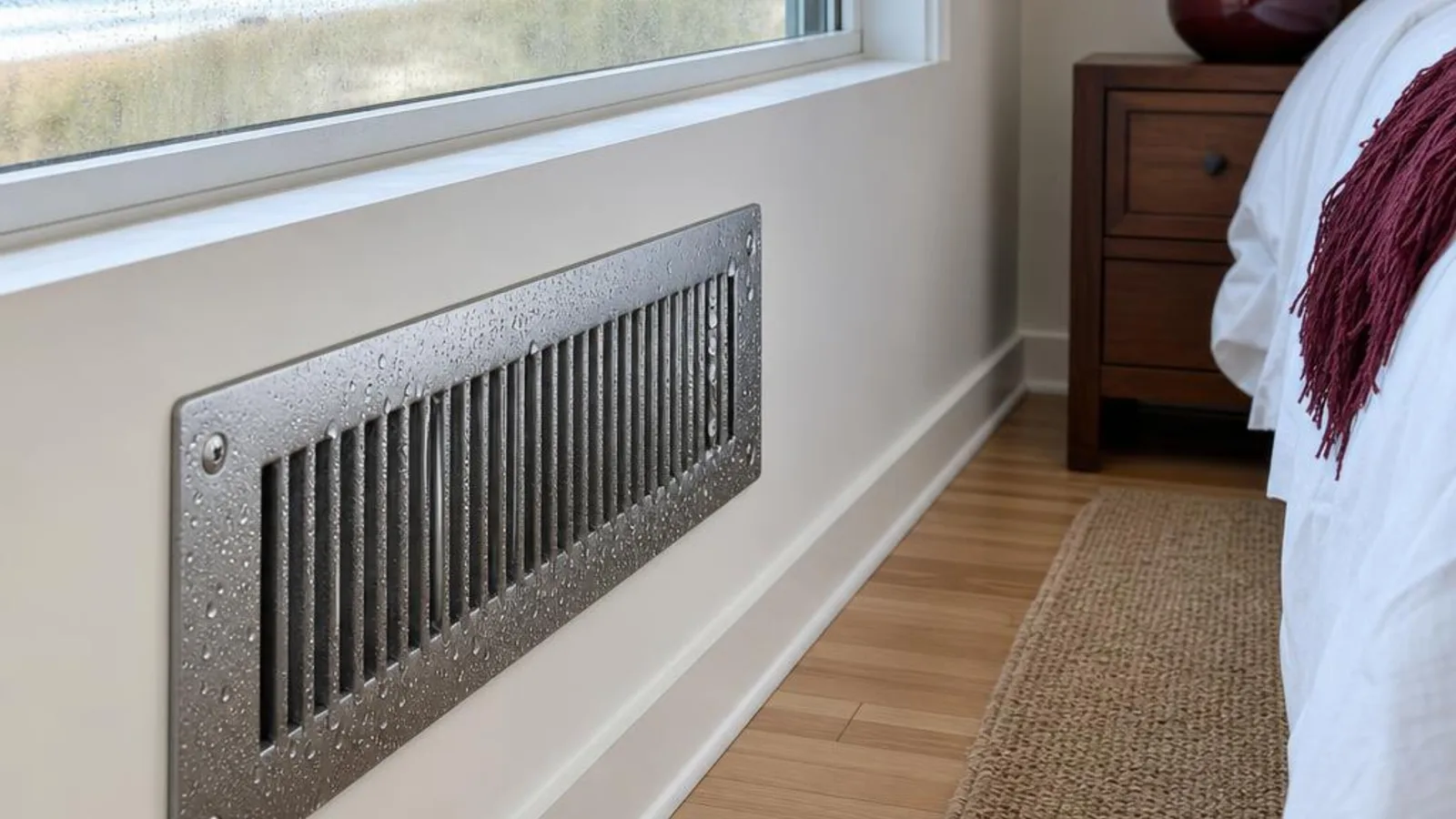
If you live near the Virginia Beach Oceanfront, Thoroughgood, or Chic’s Beach, you have probably noticed it: the rectangular grilles in your ceiling drip or collect a damp film on hot afternoons, and when the fan kicks on there is a faint musty note in the air. Both problems share the same coastal-Virginia root cause, and both are worse than a damp grille suggests.
The Physics: Why Cold Metal Plus Humid Air Equals Dripping Vents
Your supply vents deliver air that has just been chilled to 50–55°F across the evaporator coil. That cold air cools the metal grille from the inside out. Virginia Beach summers routinely push outdoor humidity above 70–80 percent relative humidity, and the warm, moisture-laden air that surrounds the grille on the room side hits that cold surface and drops below its dew point. The result is visible condensation — the same physics that makes a cold drink “sweat” on a July afternoon.
Condensation on a vent does not automatically mean your ducts are in trouble. But it does mean moisture is present at the exact point where your HVAC system contacts indoor air, and moisture in ductwork is a condition worth taking seriously.
Warning Signs That Go Beyond a Damp Grille
Occasional light condensation on the grille face is common in coastal Virginia and does not always demand action. The following signs suggest the moisture is getting deeper into the system:
- Musty or earthy odor when the A/C first runs. The blower pushes air through the duct liner before it reaches you. If the liner or accumulated dust in the duct has absorbed moisture over weeks or months, you smell it first thing every cycle.
- Visible staining around the grille. A gray or brownish ring on the ceiling drywall around the register often means condensed water is wicking outward repeatedly.
- Dripping or pooling under a ceiling register. More than a light film suggests the duct boot or the insulation around the duct has lost its vapor barrier integrity.
- Allergy-like symptoms that improve when you leave home. Accumulated organic debris in moist ductwork can circulate particles with every cycle; if household members notice relief away from home, the indoor air quality is worth investigating.
- A musty smell in only one room or zone. Localized odor often points to a specific duct run with damaged insulation, a disconnected joint allowing humid attic air in, or a section of liner that has stayed damp.
Why Wiping the Grille Is an Incomplete Fix
Cleaning the visible face of the register removes surface dust and the thin film of condensed moisture — but the grille is the end of a duct system that can run 20, 30, or 40 feet from the air handler through your attic or between floors. If humidity has entered the ductwork through a loose joint, a pinhole in the duct liner insulation, or simply through years of normal operation in a high-humidity climate, the interior of those runs can hold accumulated organic debris: skin cells, pet dander, pollen, and fine dust that has bonded to the liner surface over repeated wet-dry cycles.
Wiping the grille addresses none of that. It is the equivalent of cleaning the rim of a cup without cleaning the inside. The musty smell returns within days because the source remains undisturbed a few feet upstream.
What a Professional Inspection Actually Finds
A free photo duct inspection puts a camera inside your system before any cleaning work is recommended. In Virginia Beach homes, especially those with older flex duct or original 1970s–80s metal trunk-and-branch systems, technicians commonly observe:
- Liner material that has separated from the duct wall, creating pockets where moisture and debris collect
- Disconnected or poorly sealed joints in attic runs where humid attic air bypasses the insulation layer
- Visible debris accumulation in the trunk line where multiple runs originate
- Boot boxes (the metal transition between the duct and the register) that have rusted or pulled away from the drywall ceiling
If the inspection shows your ducts are clean and structurally sound, we say so and you spend nothing on cleaning. That honest answer is the point of inspecting before cleaning.
Cleaning: What the Process Actually Involves
When cleaning is warranted, a thorough job in a Virginia Beach home uses rotary brush agitation to break debris free from duct liner surfaces, paired with direct-contact HEPA negative-air vacuuming that captures the loosened material rather than redistributing it into your living space. Every supply line and every return is addressed. Technicians document conditions with photos before and after so you can see the difference. The work typically takes two to four hours for a single-zone home depending on duct count and layout.
Add-on treatments such as an EPA-registered antimicrobial fog are always presented as an option with a separate line-item price — never as a scare tactic or a requirement bundled into a base quote.
Moisture Control: The Long-Term Layer
Cleaning removes what has accumulated. Moisture control addresses why it accumulated. The two most common root causes in Virginia Beach are inadequate attic insulation allowing duct surface temperatures to swing too far, and duct joints that were never properly sealed. Our sister company Universal Insulation Doctor in Virginia Beach handles the insulation layer that surrounds your ductwork in the attic — properly insulated ducts stay closer to room temperature, which reduces the temperature differential that causes condensation in the first place.
On the HVAC side, ensuring the air handler is sized correctly and that the system is not over-cooling (which exacerbates condensation risk) is worth discussing with your HVAC technician if the problem persists after cleaning and sealing.
Total Home Health Subscription
Many Virginia Beach families who deal with recurring moisture and air-quality concerns skip the annual scramble with our Total Home Health Subscription — one yearly fee with tiered benefits covering duct cleaning, dryer vent cleaning, pest control, and an annual multi-point duct, attic, and crawl space inspection. The full set of services comes with the Elite plan. No contracts, cancel anytime.
If your vents are sweating or smelling musty during humid weather, call us at (757) 962-0419 or schedule a free photo inspection online. We serve every corner of Virginia Beach, from the Oceanfront to Thoroughgood to Chic’s Beach and beyond.