
Save With a Subscription Program
Indoor Air Quality

What Lives in Air Ducts? A Green-Yellow-Red Concern Guide

August 24, 2026By Universal Duct Cleaning
What Lives in Air Ducts? A Green-Yellow-Red Concern Guide

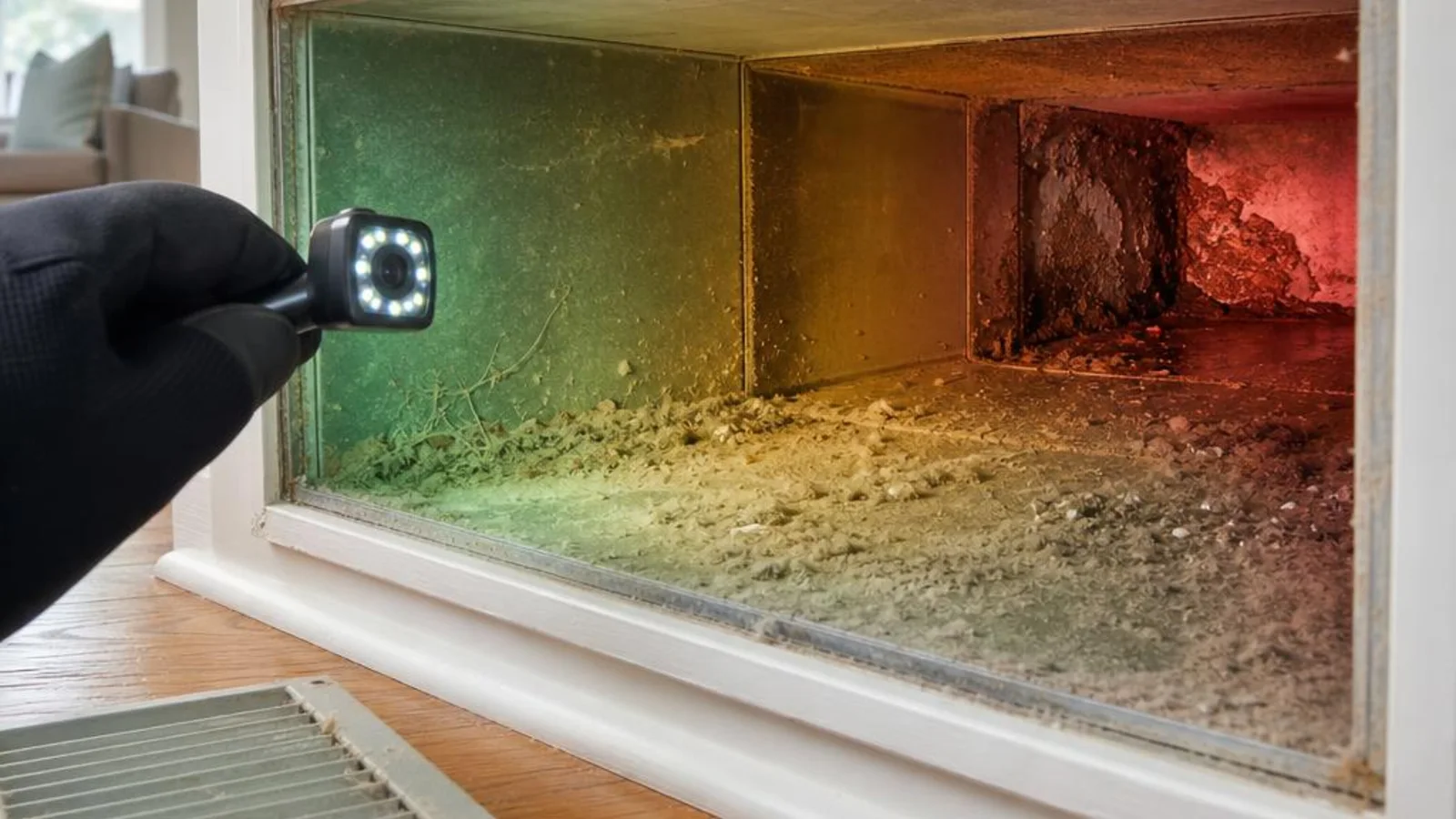
Open a return grille or point an inspection camera into a supply run and you may see a mix of ordinary household material: settled dust, lint, pollen, pet dander, and fibers carried by everyday airflow. Other findings—especially moisture, damaged duct material, or evidence of pests—deserve a different response.

The important question is not simply “Are my ducts dirty?” It is what is present, why it is there, and whether the source has been corrected. A photo inspection provides more useful information than trying to diagnose a home from an odor, a symptom, or a dark mark near a register.

What Lives in a Home’s Air Ducts? The Green-Yellow-Red Chart

Potential indoor-air concern chart
The colors rank how quickly a finding should be investigated; they are not a medical diagnosis. Individual sensitivities vary.
Concern level What may be present What it may indicate Practical next step
GREEN · Lower concern Light settled dust, lint, and household fibers Ordinary material carried by return air and normal household activity. Check the filter fit and replacement schedule. Photograph the area and monitor for increasing buildup.
YELLOW · Moderate concern Heavy dust, pollen, pet dander, renovation debris, or persistent odor residue The system may be recirculating a larger particle load. These materials can matter more to people who are already sensitive to them. Schedule a free photo inspection and review recent remodeling, filter gaps, pets, and return-air conditions.
RED · Higher concern Active moisture, water staining, mold-like material, pest nesting or waste, or visibly damaged ductwork A moisture source, pest entry point, or duct failure may need to be corrected before cleaning alone can help. Avoid disturbing unknown material. Document it, identify the source, and coordinate the appropriate duct, pest, moisture, or insulation professional.

Green: Ordinary Material That Still Deserves Monitoring

Every occupied home produces dust and fibers. Return-air grilles collect some of that material, filters capture another portion, and a small amount may settle in lower-airflow sections. A light, dry layer is different from thick deposits, damp material, or debris concentrated around a damaged connection.

Start with simple checks: confirm the filter is the correct size, look for gaps around the filter rack, and compare more than one register. If one room looks dramatically different from the rest, the issue may be local rather than system-wide.

Yellow: Material That Can Affect Sensitive Households

Pollen, pet dander, fine renovation dust, and heavier accumulations do not prove that the duct system is causing a health problem. They do show that particles are present where air moves through the home. People with existing allergies or respiratory sensitivities may react differently, so concerns about symptoms belong with a qualified healthcare professional—not an air-duct diagnosis.

For the home itself, an air duct cleaning assessment can show whether the buildup is isolated at the register or extends through accessible supply and return runs. If mechanical cleaning is recommended, ask for before-and-after photos and a written scope rather than relying on a phone estimate.

Red: Fix the Source, Not Just the Visible Debris

Moisture, pest evidence, and damaged ductwork require source control. Cleaning a damp run without finding the condensation or water source invites the condition to return. Removing visible debris without closing a pest entry point leaves the system open to another intrusion. Spraying over damaged or contaminated material is not a substitute for inspecting it.

  • Moisture or staining: document where it appears and inspect nearby duct joints, insulation, attic, or crawl-space conditions.
  • Mold-like material: do not identify it by color alone. Ask an appropriate professional whether testing or material removal is warranted.
  • Pest nesting or waste: avoid stirring it up. Address the animal or insect entry point before cleaning and repairing the affected duct section.
  • Torn, crushed, or disconnected duct: repair or replace the failed section so surrounding attic or crawl-space material is not pulled into the air path.

Our post-rodent duct decontamination, duct repair and replacement, and sanitizing treatment pages explain how those services differ. Sanitizing is an optional treatment after mechanical cleaning; it does not replace debris removal or source correction.

Why a Photo Inspection Comes Before a Recommendation

A useful inspection separates observations from assumptions. The technician should show you the accessible supply lines, returns, boots, connections, and any damaged sections; explain which findings are routine and which need action; and provide an itemized quote before work begins. If the ducts do not need cleaning, the photos should make that clear too.

Universal Duct Cleaning offers a Free Photo Inspection throughout Hampton Roads. In Norfolk, that includes neighborhoods such as Ocean View / Willoughby Spit, Ghent / West Ghent, and Berkley.

The Total Home Health Connection

Duct findings often begin outside the duct system. If an inspection reveals pest evidence, Universal Pest & Termite in Norfolk can address the entry point and active pest issue. If attic or crawl-space insulation and moisture conditions are contributing to the problem, Universal Insulation Doctor in Norfolk can evaluate that surrounding layer.

For ongoing coordination, the Total Home Health Subscription offers tiered benefits under one yearly plan. Depending on the tier, benefits can include air duct cleaning, dryer vent cleaning, pest control, and an annual multi-point duct, attic, and crawl-space inspection; the complete bundle is included with the Elite plan. There are no long-term contracts, and you can cancel anytime.

Concerned About What the Camera Might Find?

Start with evidence rather than guesswork. Request a free photo inspection or call (757) 962-0419. We will document the accessible system, explain the green, yellow, and red findings in plain language, and quote only the work you approve.

Frequently Asked Questions

What commonly lives or collects in home air ducts?

Can dirty air ducts make my family sick?

Is every dark spot inside a duct mold?

What should I do if an inspection finds rodent waste in my ducts?

When should I schedule a photo duct inspection?

Recent Inspection Findings Across Norfolk

Representative examples of the green, yellow, and red findings our crews document during Norfolk-area duct inspections. Each map number matches a job card below.

Green-Level Photo Inspection

Colley Ave, Ghent

Duct Inspection

A Ghent homeowner requested a second opinion after seeing light dust at two registers. Camera photos showed dry, routine buildup and no visible duct damage; the homeowner chose to monitor it and correct a loose filter fit.

They showed me the inside instead of trying to scare me. I appreciated being told that the system did not need an urgent cleaning.
Angela M. · Recently

Post-Renovation Debris Cleaning

Hampton Blvd, Larchmont

Air Duct Cleaning

A Larchmont-area renovation left fine drywall dust at several returns. The yellow-level finding was documented before a whole-system mechanical cleaning and filter-rack check.

The before photos showed exactly where the renovation dust had traveled, and the after photos made the result easy to verify.
Marcus T. · Recently

Moisture Finding & Referral

E Ocean View Ave, Ocean View

Duct Inspection

An Ocean View inspection documented water staining near an accessible duct connection. The crew paused cleaning recommendations until the surrounding moisture source could be evaluated.

They separated what they could clean from the moisture issue that had to be solved first. That explanation saved us from doing the steps out of order.
Denise R. · Recently

Pest-Damaged Duct Section

Berkley Ave, Berkley

Air Duct Repair

A Berkley crawl-space run showed visible damage and pest debris. The affected section was isolated for replacement after the homeowner arranged pest entry-point service.

One team documented the duct damage and connected us with the pest side so the opening was handled before the new section went in.
Calvin S. · Recently

Filter Fit & Dander Assessment

Granby St, Wards Corner

Filter Replacement

A Wards Corner home with pets had heavier yellow-level material near the return. Inspection photos pointed to an undersized filter gap as part of the particle path.

They fixed the filter fit first and gave us photos to compare before we decided on the cleaning.
Priya K. · Recently

Cleaning Followed by Optional Treatment

Military Hwy, Norfolk Highlands

Duct Sanitizing

A Norfolk Highlands system with persistent odor residue received mechanical debris removal first. The homeowner then approved an optional sanitizing treatment as a separate line item.

They were clear that the treatment came after the cleaning and was not a shortcut around removing the buildup.
Jerome L. · Recently

Ready to Breathe Cleaner Air?

Schedule your service today or request a free quote online.