

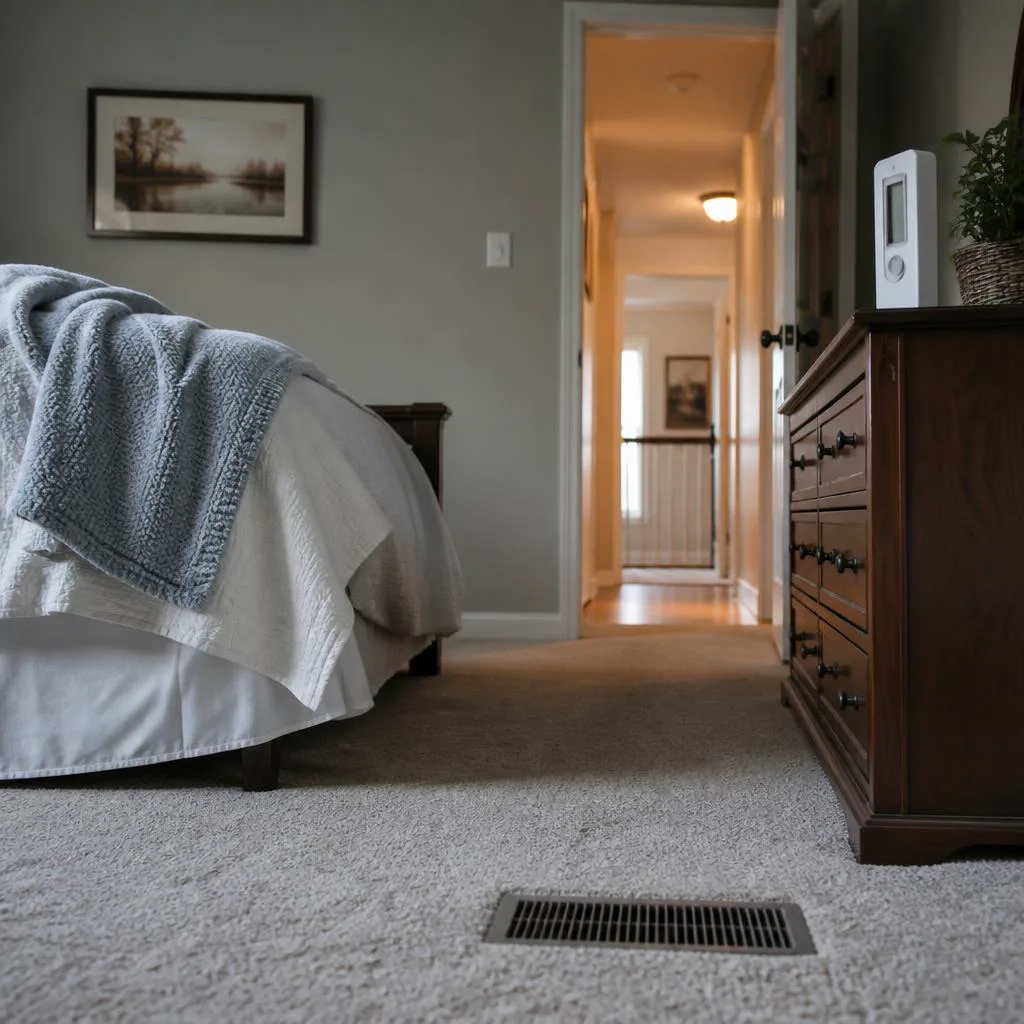
One bedroom feels five degrees colder while the rest of the house is comfortable? Homeowners in Greenbrier and Great Bridge ask this every heating season. The useful first question is not “Which company sells the biggest system?” It is “Is this room getting less warm air, losing more heat, or both?”
A temperature difference can come from several things: a blocked register, a closed or stuck damper, a long or leaking duct run, poor insulation, air leaks around a window, a closed bedroom door with a limited return-air path, or a system that needs professional balancing. The room’s location and a single thermometer reading cannot identify the cause.
Start with a simple, repeatable comparison
For a day or two, compare the chilly bedroom with a comfortable room at roughly the same time and with the thermostat setting unchanged. Keep the bedroom door in the position you usually use. Note whether the register has a steady supply of air, whether the room warms after the system runs, and whether the difference changes with sun, wind, or the door position. A small household thermometer can help you track a pattern, but it is not a substitute for a system measurement.
Then check the basics: confirm the air filter is clean and correctly fitted; make sure supply registers and return grilles are not blocked by bedding, rugs, curtains, or furniture; and check that the register damper is open. Do not close several other rooms’ supply registers to force more air into one bedroom. That can upset system airflow and may worsen comfort or equipment operation.
If airflow feels weak, ask about the delivery path
Weak airflow from one register can justify a closer look at the path between the equipment and that room. A qualified HVAC professional can check system operation and balancing. If the duct run is accessible, an inspection can also look for a disconnected, crushed, obstructed, or visibly leaking section. Do not crawl into an attic or crawlspace or open equipment panels to investigate.
ENERGY STAR explains that leaks and poor duct installation can make rooms harder to keep comfortable and that sealing and insulating accessible ducts may help. That does not mean every cold bedroom has a duct leak. Cleaning removes accumulated debris from appropriate duct surfaces; it does not reconnect a duct, seal a leak, add insulation, or adjust a heating system.
After the system is cleared as safe, Universal Duct Cleaning can document accessible runs with a free photo inspection. If you are in Chesapeake, start with our Greenbrier neighborhood page or Chesapeake service area.
If airflow seems normal, look beyond the duct
If warm air reaches the room but the room stays cold, the house may be losing heat faster there. Check for obvious drafts around the window, exterior door, attic hatch, or electrical penetrations, and note whether the bedroom sits over an unheated space or beneath an attic. ENERGY STAR lists uneven room temperatures among common signs to investigate with air sealing and insulation checks.
Sealing and insulation work should be planned with safety in mind. ENERGY STAR warns that air sealing can affect combustion appliances in some homes, so a qualified home-energy professional should evaluate combustion safety where fuel-burning equipment is present. Do not cover vents, flues, or combustion-air openings.
That distinction is practical in Chesapeake neighborhoods around Greenbrier Mall, Chesapeake City Park, and Great Bridge Lock Park. Homes and duct layouts differ street by street; no landmark or neighborhood label can tell you whether a particular room needs duct repair, insulation work, equipment service, or simply an unobstructed register.
Match the next call to the evidence
- Weak or no warm airflow: ask an HVAC professional to check equipment and balancing; request a duct inspection if the accessible delivery path may be involved.
- Normal airflow but a room that cools quickly: ask about drafts, insulation, and heat loss with a qualified home-energy professional.
- Visible debris inside accessible ducts: review the inspection photos and written scope before deciding whether cleaning is appropriate.
- Burning, gas, smoke, or electrical odor: follow the safety steps in our first-furnace-startup safety guide and do not treat it as a routine duct-cleaning issue.
Greenbrier homeowners can view the neighborhood pages for Universal Pest & Termite and Universal Insulation Doctor, plus their city-wide pages for Chesapeake pest control and Chesapeake insulation services.
The Total Home Health plans bring services from the three local companies together, but benefits differ by tier. Review the current inclusions, yearly pricing, and cancellation terms on the Total Home Health Plans page.